 Sleep Health & Wellness
Sleeping in 90 Minute Cycles: The Best Way to Wake Up Refreshed Every Morning
By Morgan Reed · Health and sleep science writer · Published April 23, 2026 · Updated April 23, 2026 · 10 min read
Learn how sleeping in 90 minute cycles can help you wake up feeling more refreshed. Discover the science behind sleep stages, how to time your bedtime, and how to use cycle-based sleep planning to reduce grogginess.
Sleeping in 90 Minute Cycles: The Best Way to Wake Up Refreshed Every Morning
Ever feel groggy after a full 8 hours of sleep? The secret might not be how long you sleep, but when you wake up, and sleeping in 90 minute cycles is the science-backed strategy that changes everything. Here's a number that might surprise you: more than half (55.6%) of recorded sleep sessions ended with a snooze alarm, even among people actively trying to optimize their wake time. That means most of us are already waking up at the wrong point in our sleep cycle, and paying for it all day.
Key Takeaways
Question
Answer
What is a 90 minute sleep cycle?
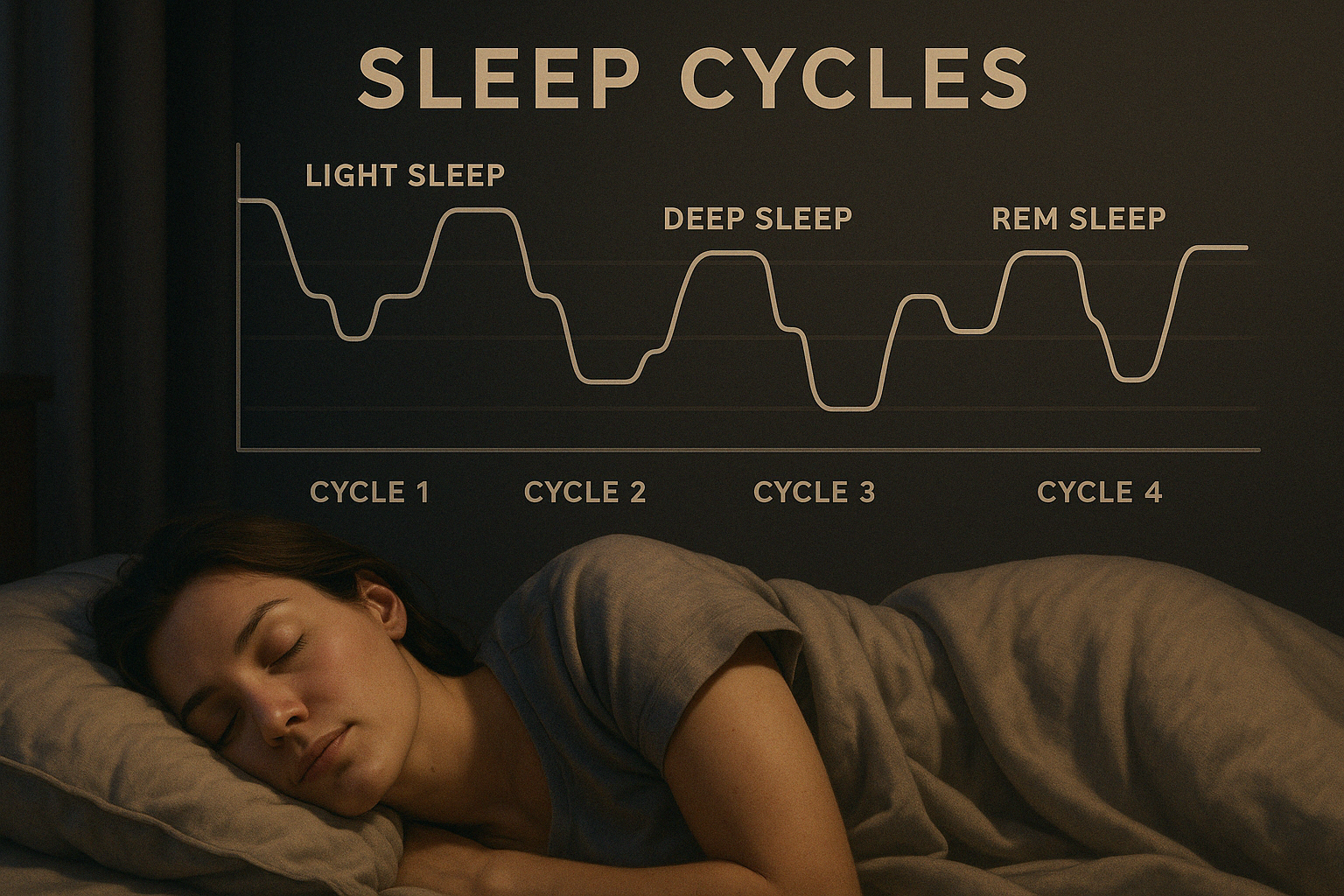
Each sleep cycle lasts roughly 90 minutes and includes light sleep, deep sleep, and REM sleep. Your body repeats this pattern 4 to 6 times per night.
Is sleeping in 90 minute cycles actually better?
Yes, waking up at the end of a complete cycle means you surface from lighter sleep, which dramatically reduces grogginess (called sleep inertia).
How many 90 minute cycles per night?
Most adults need 5 cycles (7.5 hours) for optimal rest. 4 cycles (6 hours) works in a pinch, and 6 cycles (9 hours) suits people who need more recovery time.
What time should I sleep if I wake at 6:30 AM?
Count back in 90-minute blocks from 6:30 AM (adding ~15 minutes to fall asleep): good targets are 9:00 PM, 10:30 PM, or midnight.
Can a calculator help me sleep in 90 minute cycles?
Absolutely. Our Sleep Cycle Calculator does the math for you based on your age group and target wake time, with no account required.
Does everyone have exactly 90 minute cycles?
Not exactly. Research suggests the median cycle duration is actually closer to 96 minutes, so your personal cycle may vary slightly from the standard 90-minute estimate.
Is this approach backed by science?
Yes. The 90-minute cycle framework is grounded in sleep architecture research referenced by institutions like the NIH, NSF, and AASM.
What Actually Happens When You're Sleeping in 90 Minute Cycles
Your brain doesn't just "turn off" when you go to sleep. It moves through a structured sequence of stages, and sleeping in 90 minute cycles is simply working with that natural architecture instead of against it.
Each cycle covers four stages: N1 (light sleep), N2 (deeper relaxation), N3 (deep/slow-wave sleep), and REM (rapid eye movement, where most dreaming happens). Together, those stages take roughly 90 minutes to complete.
Early in the night, your cycles are dominated by deep (N3) sleep, which is critical for physical recovery, immune function, and memory consolidation. Later cycles shift toward more REM sleep, which supports emotional regulation and creative thinking.
This is why waking up mid-cycle feels awful. If your alarm pulls you out of deep sleep, your brain hasn't finished what it was doing, and you end up foggy, irritable, and reaching for three cups of coffee.
Why Sleeping in 90 Minute Cycles Works Better Than Just Counting Hours
Most people focus on hitting "8 hours" without thinking about where in their cycle they'll wake up. But two people can both sleep 8 hours and have very different mornings depending on when their alarm fires.
Eight hours divided by 90 minutes gives you roughly 5.3 cycles, which means a standard 8-hour night doesn't actually land at the end of a complete cycle. That explains a lot of unnecessary morning grogginess.
Sleeping in 90 minute cycles solves this by targeting wake times that align with natural cycle endpoints. The most practical options for a full night's rest are:
- 4 cycles = 6 hours (minimum for most adults)
- 5 cycles = 7.5 hours (the sweet spot for most people)
- 6 cycles = 9 hours (ideal for recovery days or if you're sleep-deprived)
Notice that 7.5 hours, not 8, is what the cycle math produces for five complete cycles. That's exactly what our sample Sleep Quality Report shows: 5 sleep cycles, 7.5 hours, as the benchmark for a refreshing night.
It's not just about how long you sleep. It's when you wake up within that time that determines how you feel.
Best Wake Times Based on Sleeping in 90 Minute Cycles
The easiest way to apply the 90-minute rule is to work backward from your desired wake time, counting back in 90-minute blocks, and then adding about 15 minutes for the time it typically takes to fall asleep.
Here's a practical reference table for common wake times:
Wake Time
4 Cycles (6h)
5 Cycles (7.5h)
6 Cycles (9h)
6:00 AM
11:45 PM
10:15 PM
8:45 PM
6:30 AM
12:15 AM
10:45 PM
9:15 PM
7:00 AM
12:45 AM
11:15 PM
9:45 PM
7:30 AM
1:15 AM
11:45 PM
10:15 PM
8:00 AM
1:45 AM
12:15 AM
10:45 PM
These times account for roughly 15 minutes of sleep-onset time. If you tend to fall asleep quickly or slowly, adjust accordingly.
Want the math done for you automatically? Our Sleep Cycle Calculator generates personalized bedtime and wake-time options based on your age group, no account needed.
The Real Truth About 90 Minute Sleep Cycles (What Most Articles Get Wrong)
Here's something most "sleep hack" content skips over: the 90-minute figure is an average, not a guaranteed fixed unit for every person.
Your individual cycle length can shift based on age, stress levels, alcohol intake, medications, and how sleep-deprived you are. First cycles of the night tend to be longer and heavier on deep sleep, while later cycles lean more into REM.
Did You Know?
According to a 2024 National Sleep Foundation paper, the median sleep cycle duration was actually 96 minutes, not exactly 90 — meaning many popular calculators may be slightly off for the average person.
Source: Sleep Health: Journal of the National Sleep Foundation (2024)
What does this mean practically? The 90-minute rule is a solid, research-supported starting point, but you should treat it as a window rather than an exact alarm-clock time.
If you consistently wake up feeling groggy even when timing your sleep by the cycle, try shifting your alarm 5 to 10 minutes earlier or later. Small adjustments can make a big difference in how you land relative to your actual cycle endpoint.
We built our calculator around this same science-based thinking: using cycles of approximately 90 minutes and flagging that cycles repeat 4 to 6 times per night, so the tool gives you a range of recommended times rather than a single rigid option.
Who Benefits Most from Sleeping in 90 Minute Cycles
Honestly? Almost everyone can benefit from this approach. But certain groups tend to see the most dramatic improvement when they start timing their sleep around complete cycles.
- People who feel groggy despite "enough" sleep: If you regularly get 7-8 hours but still drag through mornings, cycle timing is almost certainly the missing piece.
- Shift workers and irregular schedulers: When your sleep window is constrained, hitting a clean 4-cycle block (6 hours) beats a messy 7 hours cut off mid-cycle.
- Students and high-focus professionals: REM sleep (which appears heavily in later cycles) is directly tied to memory consolidation and problem-solving, making cycle completion critical before exams or big meetings.
- Parents of young children: If you can only grab a short sleep window, knowing the best "exit points" helps you plan around your baby's schedule more strategically.
- People recovering from illness or intense exercise: Deep sleep cycles do the physical repair work. Completing more cycles means more recovery time in those restorative N3 stages.
Age also plays a role. Teenagers need more total sleep (8-10 hours, or roughly 5-6+ cycles), while older adults often naturally shift toward lighter cycles. Our calculator accounts for this using National Sleep Foundation age-based guidelines, which is why selecting your age group when calculating is worth the extra second.
How to Start Sleeping in 90 Minute Cycles Tonight
Good news: you don't need any special equipment to try this. Here's a simple approach you can implement right now.
- Pick your wake time first. Work with your actual schedule, not an ideal one. Be realistic about when your alarm needs to go off.
- Count back in 90-minute blocks. Add 15 minutes to account for falling asleep. Aim for a bedtime that lands at 4, 5, or 6 complete cycles before your alarm.
- Start a consistent wind-down routine 30-45 minutes before your target bedtime. Dim lights, put the phone down, and let your body temperature drop naturally.
- Set a single alarm (no snooze). We know this one's tough, but snoozing pulls you back into a new, incomplete mini-cycle and makes the grogginess worse.
- Track how you feel over 5-7 days. Note your energy levels, focus, and mood in the morning. Adjust your bedtime by 5-10 minutes if needed.
The biggest barrier most people face is inconsistency. Going to bed at the right time on a Tuesday but two hours later on a Friday resets the progress your body made toward a stable rhythm. Aim for at least weekday consistency as a starting point.
Tools That Help You Sleep in 90 Minute Cycles
You can absolutely do the math yourself, but having a tool removes the friction on nights when your bedtime is unpredictable or you're working from a different wake time than usual.
Our Sleep Cycle Calculator is built specifically around the 90-minute framework. You enter your desired wake time (or current time if you're about to go to bed), select your age group, and the calculator returns a set of optimal bedtimes aligned with complete cycles.
What makes it genuinely useful is the Sleep Fit Score, a color-coded metric that shows how well your planned sleep duration matches the NSF-recommended range for your age. If you're aiming for "Excellent," you'll see that reflected clearly before you even close your laptop.
No account required, no subscription, no data collection beyond what's needed for the calculation itself. Just a clean, fast tool that does what it says.
For people who want to go deeper, AI-powered sleep monitoring is becoming a practical option in 2026, with contactless radar, infrared, and sound-based sensors that can track your actual cycle transitions without you wearing anything. This kind of technology can tell you where your specific cycles actually end, rather than relying on the population average.
Common Mistakes When Trying 90 Minute Sleep Cycles
People who try the 90-minute approach and don't get results usually make one of a handful of predictable mistakes. Here are the ones we see most often.
Mistake 1: Ignoring sleep onset time. If you lie down at 10:30 PM but spend 25 minutes scrolling before actually falling asleep, your cycles start at 10:55 PM, not 10:30. Add that buffer in.
Mistake 2: Hitting snooze anyway. This one is almost universal, and the data backs it up.
Did You Know?
The average snooze alarm use was about 11 minutes per day according to a Scientific Reports study. That extra 11 minutes drops you into a new, incomplete sleep stage, often making you feel worse than if you'd just gotten up at the intended cycle end.
Source: Snooze alarm use in a global population of smartphone users (Scientific Reports, 2025)
Mistake 3: Expecting instant results. Your circadian rhythm takes several days to adjust to a new schedule. Give the approach at least a full week before judging whether it works for you.
Mistake 4: Applying the math rigidly on weekends. Sleeping in two hours on Saturday shifts your rhythm enough that Monday morning feels like mild jet lag. Keep your wake time within an hour of your weekday time.
Mistake 5: Not accounting for age-related differences. A 19-year-old and a 55-year-old have different recommended total sleep amounts. Cycle timing helps both, but the target number of cycles differs. Using age-based guidelines, like those built into our calculator, keeps your expectations calibrated correctly.
"It's not just about how long you sleep. It's when you wake up within that time that determines how you feel in the morning."
Sleeping in 90 Minute Cycles vs. Other Sleep Optimization Strategies
There are a lot of sleep optimization strategies floating around in 2026, from "sleepmaxxing" trends on social media to expensive smart mattresses and AI-tracked biometrics. Where does the 90-minute cycle approach sit among all of that?
Honestly, it's foundational. Most other strategies work better on top of solid cycle timing, not as replacements for it.
- vs. Sleep tracking wearables: Wearables tell you what happened last night. Cycle-based planning helps you shape what will happen tonight. They complement each other well.
- vs. Melatonin or sleep supplements: Supplements can help with sleep onset but don't structure your cycles. Timing is still what matters when the alarm goes off.
- vs. Biphasic or polyphasic sleep: Napping strategies (like a 20-minute power nap or a 90-minute full-cycle nap) are also built on cycle awareness. A 90-minute nap that completes one full cycle can meaningfully restore alertness for people who are sleep-deprived.
- vs. "8 hour rule" advice: The fixed-hour approach ignores individual cycle variation. Cycle-based timing is more adaptive and more likely to produce a consistent result.
The 90-minute cycle framework isn't a trend. It's grounded in decades of sleep architecture research and referenced by institutions like the NIH, AASM, and the National Sleep Foundation. The difference in 2026 is that practical tools now make it accessible to anyone, not just people who can afford a sleep lab.
Conclusion
Sleeping in 90 minute cycles is one of the most practical, low-cost changes you can make to improve how you feel every single morning. The science is clear: your brain follows a structured sleep architecture, and aligning your alarm with the natural endpoint of a complete cycle dramatically reduces sleep inertia and improves how sharp you feel throughout the day.
The formula is simple. Pick your wake time, count back in 90-minute blocks, add 15 minutes for sleep onset, and aim for 5 complete cycles (7.5 hours) as your default target. From there, adjust based on how you feel after a week of consistency.
If you want the math done instantly, try our Sleep Cycle Calculator for personalized bedtime recommendations based on your age and schedule. No sign-up, no friction, just better mornings.
Sleep better, live better. It really does start with sleeping in 90 minute cycles.
Frequently Asked Questions
Is sleeping in 90 minute cycles actually scientifically proven?
Yes, the 90-minute sleep cycle framework is based on well-established sleep architecture research. Studies published through institutions like the NIH and the National Sleep Foundation confirm that most adults cycle through sleep stages in roughly 90-minute intervals, repeating 4 to 6 times per night. The exact duration varies by individual, with research suggesting the median is closer to 96 minutes for some populations.
What happens if I wake up in the middle of a 90 minute sleep cycle?
Waking mid-cycle means your alarm pulls you out of deep or REM sleep, triggering what researchers call sleep inertia, which is the grogginess, disorientation, and poor cognitive function that can last 30 minutes to over an hour. This is exactly the feeling that sleeping in 90 minute cycles is designed to prevent by timing your alarm at the natural end of a cycle, when you're in lighter sleep.
How do I calculate my bedtime using 90 minute sleep cycles?
Start with your required wake time and subtract 90 minutes for each cycle you want to complete, then add 15 minutes for sleep onset. For example, if you need to wake at 7:00 AM and want 5 cycles, subtract 7.5 hours and add 15 minutes, giving a target bedtime of 11:15 PM. Our free sleep calculator handles this math automatically, including adjustments for your age group.
Is 7.5 hours better than 8 hours of sleep?
For many adults, yes. Seven and a half hours represents 5 complete 90-minute cycles, meaning you wake at a natural cycle endpoint rather than mid-cycle. Eight hours doesn't divide evenly into 90-minute blocks, which often means waking during deep or REM sleep and feeling groggier despite the extra time in bed. That said, individual needs vary, and age-based guidelines from the National Sleep Foundation are worth checking for your specific group.
Can I use the 90 minute cycle method for naps?
Absolutely. A 90-minute nap completes one full sleep cycle and is one of the most effective nap lengths for full cognitive and physical restoration. Shorter 20-minute naps work well for alertness without entering deep sleep, while 90-minute naps deliver a complete cycle including REM. Avoid naps that fall somewhere in between, like 45 or 60 minutes, since those tend to cut you off in deep sleep and leave you feeling worse.
Does age affect how well the 90 minute cycle method works?
Age affects how many total cycles you need and how your cycles are distributed, but the 90-minute framework applies across most adult age groups. Teenagers typically need more cycles per night (often 6 or more), while older adults may find their cycles shift slightly and their deep sleep stages shorten naturally. Using age-aligned recommendations, like the NSF guidelines our calculator references, helps you target the right total sleep duration for your life stage.
What's the best app or tool for sleeping in 90 minute cycles in 2026?
In 2026, your options range from simple web-based calculators to AI-powered contactless monitoring systems that track your actual cycle transitions in real time. For a quick, no-fuss starting point, our Sleep Cycle Calculator at SleepWise is free to use without creating an account and gives you personalized bedtime windows based on your age and wake time. For deeper insight into your actual cycle patterns, contactless AI sleep monitoring tools using radar or acoustic sensors are becoming increasingly accurate and accessible.