 Sleep Tech & Wellness
SleepFM: Predictive Health via AI Foundation Models, Explained
By Morgan Reed · Health and sleep science writer · Published July 1, 2026 · Updated July 1, 2026 · 8 min read
SleepFM is changing how researchers think about sleep data. Learn how this AI foundation model uses clinical sleep signals and long-term health records to forecast disease risk, support predictive health tracking, and shape the future of AI sleep diagnostics in 2026.
SleepFM: Predictive Health via AI Foundation Models, Explained (and Why It Matters for Your Sleep)
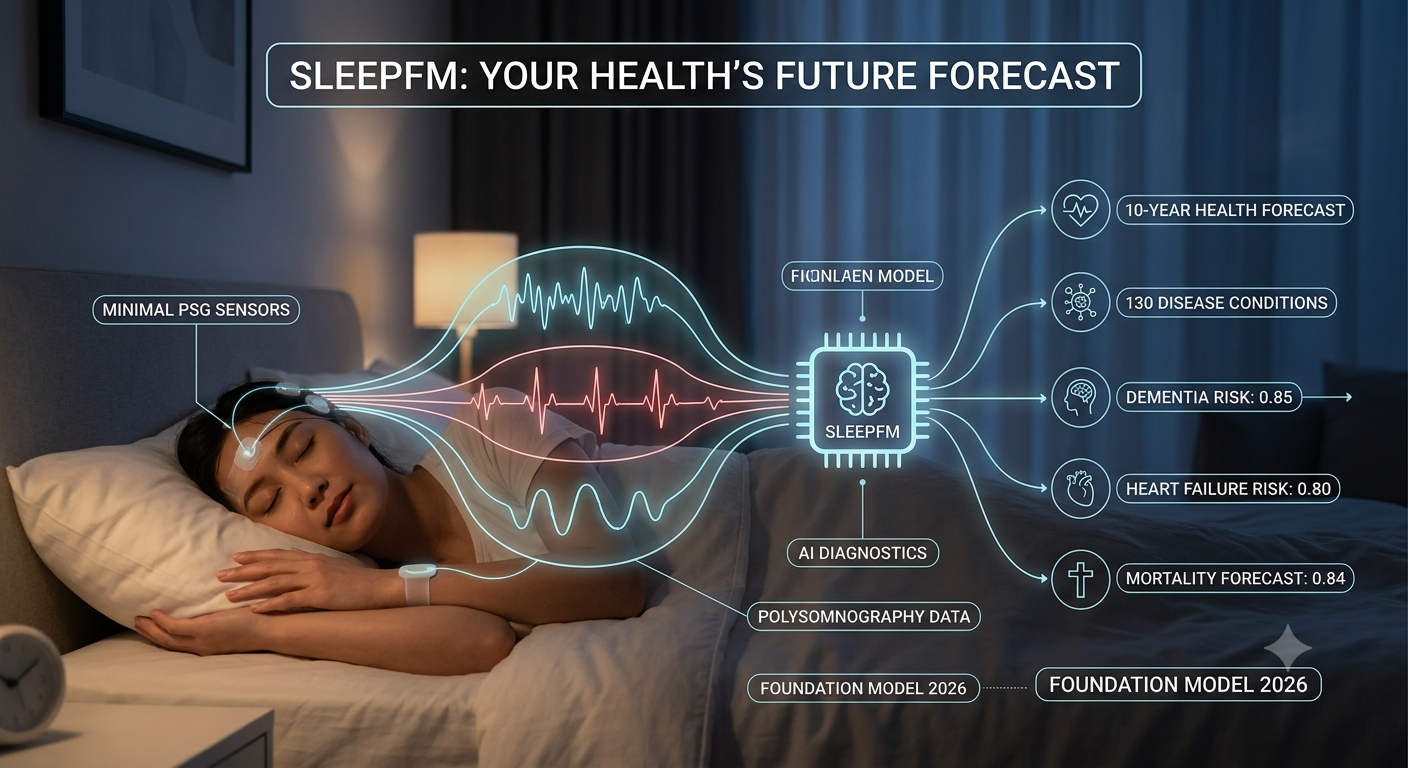
Here's a number that stopped us in our tracks: researchers have built an AI model that can predict 130 different health conditions from a single night of sleep data. That's SleepFM, and it's quietly becoming one of the most talked-about names in predictive health tracking. SleepFM: Predictive Health via AI Foundation Models is the kind of project that makes you rethink what a "good night's sleep" actually tells your body.
Let's be honest. Most of us think about sleep in terms of how groggy we feel in the morning. SleepFM thinks about it in terms of dementia risk, heart failure, and mortality, ten years out. That's a different conversation entirely, and we want to walk you through it without the jargon.
Key Takeaways
- What it is: SleepFM is an AI foundation model trained on hundreds of thousands of hours of sleep study data to forecast long-term disease risk, not just track your sleep stages.
- The scale: It was trained on 585,000 hours of polysomnography data from 65,000 participants, paired with 25 years of follow-up medical records.
- The accuracy: Early benchmarks show C-index scores of 0.85 for dementia risk and 0.84 for all-cause mortality, both considered strong predictive accuracy in clinical research.
- Why it's different: Traditional consumer sleep trackers measure last night. Foundation models like SleepFM are built to forecast the next decade.
- What it doesn't replace: A predictive score isn't a diagnosis, and it definitely isn't a substitute for understanding your own sleep health fundamentals.
- The takeaway for you: AI sleep diagnostics are moving from "how did I sleep" to "what is my sleep telling me about my future health," and that shift is worth paying attention to in 2026.
What Is SleepFM? Predictive Health via AI Foundation Models, Plain and Simple
SleepFM is what researchers call a "foundation model" for sleep. If you've heard that term applied to chatbots or image generators, it's the same basic idea applied to physiology instead of language.
Instead of training a narrow algorithm to do one job (say, detect sleep apnea), researchers trained SleepFM on a huge, varied pool of raw sleep signals. Brain waves. Heart rhythm. Breathing patterns. Then they let the model learn the deep structure of human sleep on its own, the same way a language model learns grammar without being explicitly taught a rulebook.
The result is a model that can be pointed at dozens of different questions: What stage of sleep is this? Does this pattern suggest a heart problem? What does this person's risk of dementia look like in a decade? One model, many predictions. That's the foundation model approach, and it's why 2026 is shaping up to be a turning point year for AI sleep diagnostics.
How SleepFM Learns: Inside the Dataset Behind the Model
Here's the part that genuinely impressed us. SleepFM wasn't trained on a few thousand nights of sleep from a small study group.
It was trained on 585,000 hours of polysomnography recordings, sourced from roughly 65,000 participants. Polysomnography, for anyone who hasn't had one, is the full overnight sleep study, electrodes and all, that measures brain activity, eye movement, heart rate, and breathing simultaneously.
The participants ranged in age from 2 to 96, which matters more than it sounds. A model trained only on middle-aged adults misses the way sleep architecture shifts in kids, teens, and older adults. SleepFM had to learn the whole spectrum.
Stanford Medicine provided a massive dataset spanning 25 years to train SleepFM.
What really sets this dataset apart is the time horizon. Researchers paired each sleep recording with up to 25 years of follow-up health records. That means the model didn't just learn what a healthy brain wave looks like tonight. It learned what a healthy brain wave looks like compared to someone who developed heart failure eight years later.
That's the whole trick behind predictive health tracking done right. You need the sleep data and the long-term outcome data, linked together, at scale.
SleepFM: Predictive Health via AI Foundation Models for 130+ Conditions
So what can this model actually predict? Researchers screened roughly 1,000 disease categories from medical records to find which ones showed a measurable link to sleep patterns.
They landed on 130 conditions where SleepFM could forecast risk with reasonable accuracy from a single night's sleep study. That list spans cardiovascular disease, neurological conditions like dementia, metabolic disorders, and more.
We want to be clear about what this does and doesn't mean. It doesn't mean a sleep study can replace a full medical workup. It means your sleep architecture, the way your body cycles through light, deep, and REM sleep, carries far more diagnostic information than most of us ever assumed.
One night of sleep data, run through the right model, can flag risk signals that would otherwise take years (and a lot of doctor visits) to surface.
AI Sleep Diagnostics: How Accurate Is SleepFM, Really?
Accuracy numbers in medical AI get thrown around a lot, so let's ground this in actual figures researchers have published.
Health Outcome
Predictive Accuracy (C-index)
What This Means
Dementia (10-year risk)
0.85
Strong predictive performance
All-cause mortality
0.84
Strong predictive performance
Heart failure (10-year risk)
0.80
Solid, clinically useful accuracy
Myocardial infarction (heart attack)
0.81
Solid, clinically useful accuracy
For context, a C-index of 0.50 is basically a coin flip. A C-index of 1.0 is perfect prediction. Scores in the 0.80 to 0.85 range, which is where SleepFM consistently lands, are considered genuinely useful in clinical risk modeling.
Researchers also found SleepFM outperforms baseline models (the ones using only demographics or raw data without foundation model pretraining) by 5% to 17%. That gap is the entire point of foundation models 2026 style: pretraining on massive, varied data makes the model smarter at every downstream task, not just one.
Foundation Models 2026: Why This Approach Beats Older AI Sleep Tools
Older sleep-tracking algorithms were built narrow on purpose. One model classified sleep stages. A different model flagged apnea events. Neither talked to the other.
SleepFM's foundation model architecture changes that math. By learning a shared, general-purpose understanding of sleep signals first, then fine-tuning for specific predictions later, the model gets better at everything simultaneously.
There's a technical benchmark that backs this up. SleepFM's learned embeddings (think of these as the model's internal "understanding" of a sleep signal) hit 48% top-1 accuracy when asked to match clips across 90,000 candidates from different recording types. More tellingly, a downstream model built on those embeddings scored 0.88 macro AUROC on sleep stage classification, compared to 0.72 for a standard convolutional neural network trained the old way.
That's not a small improvement. That's the difference between a model that's pretty good and one that's genuinely reliable.
Did You Know?
SleepFM's dementia risk model hit a 0.85 Concordance index, one of the strongest predictive accuracy scores recorded for a 10-year forecast built from sleep data alone.
Source: Mattress Miracle
SleepFM vs Traditional Sleep Trackers: What's Actually Different
If you wear a smartwatch to bed, you already get a sleep score every morning. So what's the difference here?
Consumer trackers are mostly looking backward. They tell you how last night went, maybe how this week compares to last week. Useful, sure, but limited.
SleepFM and models like it are looking forward, and at a much bigger question than "did I sleep well." Here's the contrast laid out simply:
- Consumer wearables → estimate sleep stages using motion and heart rate → give you a nightly score → help with habit-building.
- SleepFM-style foundation models → analyze full polysomnography-grade signals → cross-reference against decades of outcome data → forecast disease risk years in advance.
Neither replaces the other. Your smartwatch is great for noticing that your bedtime keeps slipping later. A clinical-grade foundation model is built for a doctor trying to understand your long-term cardiovascular risk.
Predictive Health Tracking: From One Night to a Decade of Risk
The phrase "predictive health tracking" gets used loosely these days, so let's be precise about what it means in this context.
It means taking a single data point (your overnight sleep study) and using it to estimate something that hasn't happened yet (your risk profile a decade from now). That's a genuinely new capability in mainstream health tech, and it's why outlets like Stanford Medicine and Nature have covered SleepFM so closely.
We'd also push back gently on the idea that this is some kind of crystal ball. A risk score is a probability, not a prophecy. High dementia risk doesn't mean dementia is coming. It means a conversation with your doctor about prevention just got a lot more specific.
Where SleepFM Fits Into the AI Sleep Diagnostics Landscape
SleepFM isn't operating alone. It's part of a broader wave of AI sleep diagnostics research happening right now, and 2026 has seen several research groups racing to build on the same foundation model approach.
What makes SleepFM stand out is the sheer scale of training data and the breadth of conditions it covers. Most competing models focus on one or two outcomes, usually apnea detection or basic sleep staging. SleepFM's 130-condition reach is unusually broad for a single model.
Did You Know?
SleepFM was trained on 585,000 hours of overnight sleep recordings collected from 65,000 participants, then paired with 25 years of medical follow-up data.
Source: Stanford Medicine
This research has also been published in peer-reviewed venues, including coverage in Nature, which gives the underlying methodology more credibility than a typical tech press release.
What This Means for Your Sleep Right Now
Okay, so clinical-grade foundation models are impressive. But you're probably not getting a polysomnography study run through SleepFM this week.
Here's the thing. While the research world builds toward this kind of predictive future, the basics still matter more than ever. Good sleep architecture, the kind SleepFM is trained to recognize as healthy, doesn't come from a gadget. It comes from consistent timing, complete sleep cycles, and a wind-down routine that doesn't fight your biology.
That's not us downplaying the tech. It's us being honest that you don't need a research-grade AI model to start improving your own sleep tonight. Understanding your own 90-minute sleep cycles and timing your wake-up around them is still one of the most practical levers available to anyone, no lab equipment required.
Is SleepFM Available to the Public Yet?
Short answer: not in the way a consumer app is available. SleepFM currently lives in research and clinical settings, the kind of environment with full polysomnography equipment and institutional review.
What's more likely in the near term is that insights from foundation models like this one trickle down into consumer products. Expect smartwatch makers and sleep app developers to license or mimic this research throughout 2026 and beyond, gradually narrowing the gap between lab-grade prediction and what shows up on your phone screen each morning.
If you have questions about how any of this applies to your own sleep tracking choices, our team is always happy to talk it through, you can reach us through our contact page anytime.
Conclusion: Should You Care About SleepFM in 2026?
SleepFM: Predictive Health via AI Foundation Models represents a real shift in what sleep data can tell us, not just about tonight, but about the next ten years of your health. The accuracy numbers (0.85 for dementia, 0.84 for mortality, 0.80 for heart failure) are strong enough that clinical researchers are taking this seriously, and so should you.
That said, none of this replaces the fundamentals. Good sleep hygiene, consistent cycle timing, and honest attention to how your body actually feels still do most of the heavy lifting. Foundation models like SleepFM are a powerful new lens for understanding sleep's connection to long-term health. They're not a replacement for the basics, and they're not available as a consumer product yet. But the direction is clear: predictive health tracking is moving fast, and sleep is turning out to be one of the richest data sources we have.
Frequently Asked Questions
What is SleepFM and how does it work?
SleepFM is an AI foundation model trained on hundreds of thousands of hours of overnight sleep study data to predict long-term health risks. It learns patterns from brain waves, heart rhythm, and breathing, then uses those patterns to forecast conditions like dementia, heart failure, and mortality risk years in advance.
How accurate is SleepFM at predicting disease risk?
SleepFM has shown C-index scores of 0.85 for 10-year dementia risk, 0.84 for all-cause mortality, and 0.80 for heart failure risk. These scores indicate strong, clinically meaningful predictive accuracy, well above baseline models that don't use foundation model pretraining.
Can SleepFM predict heart disease from a single night of sleep?
Yes. Research shows SleepFM can estimate myocardial infarction risk with a C-index of 0.81 using data from just one overnight sleep study, part of its broader ability to flag risk across 130 different health conditions.
Is SleepFM available for consumers to use in 2026?
Not yet in a direct, consumer-facing app. SleepFM currently operates in research and clinical settings using full polysomnography data, though consumer sleep trackers may incorporate similar foundation model techniques over time.
How is SleepFM different from a smartwatch sleep tracker?
Smartwatches estimate sleep stages from motion and heart rate to give you a nightly score looking backward at last night. SleepFM analyzes clinical-grade sleep signals against decades of medical outcomes to forecast disease risk years into the future, a fundamentally different kind of predictive health tracking.
What data was used to train SleepFM?
SleepFM was trained on 585,000 hours of polysomnography recordings from roughly 65,000 participants ranging in age from 2 to 96, paired with up to 25 years of follow-up medical records to link sleep patterns to long-term health outcomes.
Does using AI sleep diagnostics mean I don't need good sleep habits anymore?
No, and we'd push back hard on that idea. AI sleep diagnostics like SleepFM are about understanding risk, not replacing the fundamentals of consistent sleep timing, complete sleep cycles, and basic sleep hygiene that still drive how you actually feel day to day.