 Sleep Tech & Wellness
Haptic Safety Signaling for Middle-of-the-Night Awakenings
By Morgan Reed · Health and sleep science writer · Published July 1, 2026 · Updated July 1, 2026 · 7 min read
Waking up anxious at 3 AM can turn a normal sleep interruption into a panic spiral. Learn how haptic safety signaling uses gentle wearable vibration patterns to calm the nervous system, support sleep anxiety relief, and help you fall back asleep without light or sound.
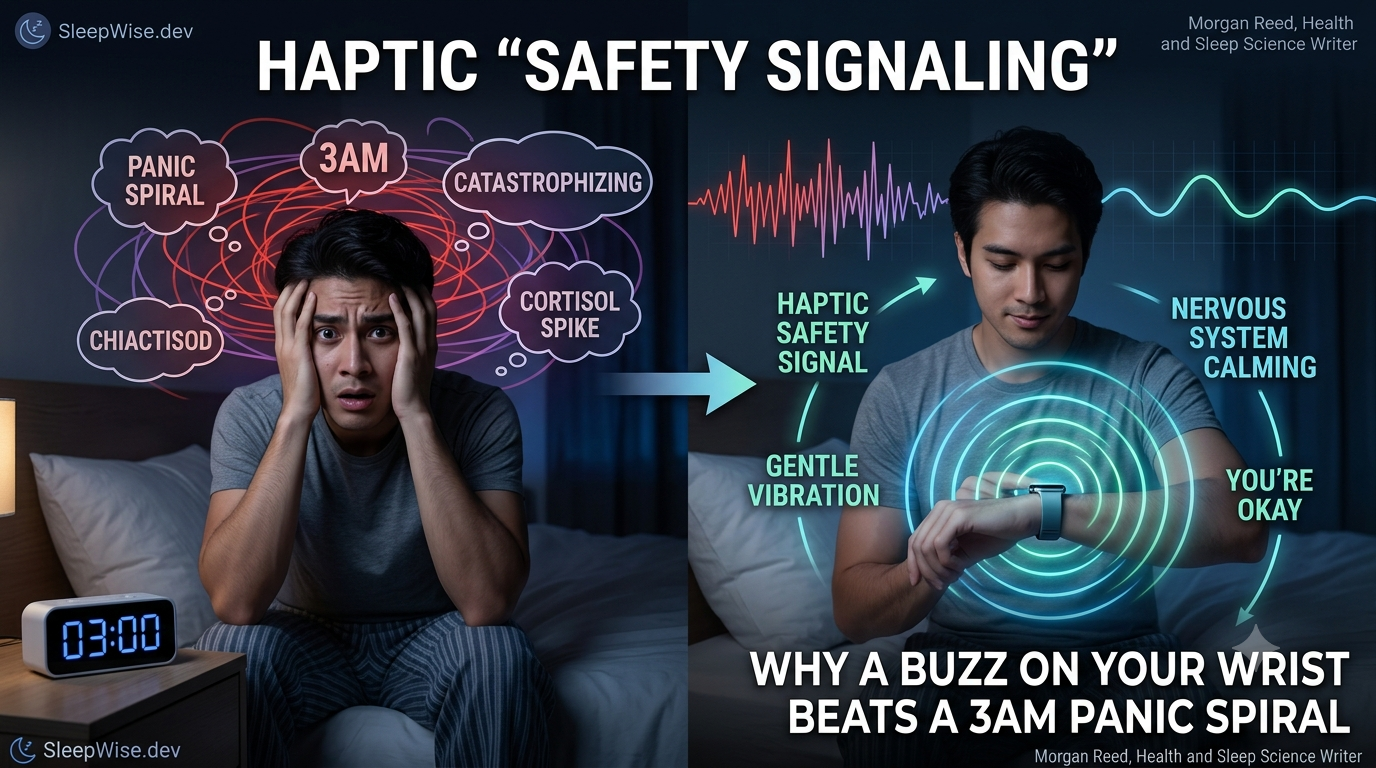
Haptic "Safety Signaling" for Middle-of-the-Night Awakenings: Why a Buzz on Your Wrist Beats a 3AM Panic Spiral
You wake up at 3 AM, heart pounding, and your brain immediately starts cataloging every possible disaster. Roughly 70 million American adults deal with chronic sleep problems just like this, and a growing number of them are turning to haptic "safety signaling," a gentle vibration pattern designed to tell your nervous system "you're okay" before the anxiety spiral even gets going.
Let's be honest. Waking up at 3 AM gripped by anxiety is not a character flaw or a sign that something is permanently broken. It's a biological pattern, and patterns can be interrupted.
Key Takeaways
- What it is: Haptic safety signaling uses subtle wrist or body vibration to calm the nervous system during middle-of-the-night wakeups, instead of relying on light or sound.
- Why it works: Touch-based feedback bypasses the part of your brain doing the late-night catastrophizing and talks directly to your body's threat-detection system.
- Who needs it most: People with sleep anxiety, older adults at fall risk, and anyone stuck in the "wake up panicked → check the time → can't fall back asleep" loop.
- The market is moving fast: The insomnia segment alone makes up 52.3% of the wearable sleep tracker market, and watches and bands deliver the haptic feedback for 58.2% of that market.
- It's not a magic cure: Haptic feedback is a tool, not a substitute for good sleep habits, sleep cycle awareness, or addressing underlying sleep anxiety.
- Pair it with free tools: Combining a haptic sleep aid with our free sleep cycle calculator (no account required) gives you both the tech and the science-backed timing to actually use it well.
- Learn the "why" behind 3 AM waking: Read more about our editorial approach to sleep science on the SleepWise about page.
What Is Haptic Safety Signaling, Really?
Haptic safety signaling is exactly what it sounds like: a vibration, usually from a wearable, that signals safety to your body when you wake up unexpectedly.
Think of it as a tap on the shoulder that says "everything's fine" instead of a blaring notification that says "something's wrong." That distinction matters more than it sounds like it should.
Most of us associate phone buzzes and alarm vibrations with urgency. Haptic safety signaling flips that script, using a slower, rhythmic pulse pattern (often mimicking a calm heartbeat or slow breathing rhythm) that your nervous system learns to associate with "this is not an emergency."
The goal isn't to wake you up further. It's to keep a middle-of-the-night awakening from turning into a full-blown 3 AM panic spiral.
Why Your Brain Panics at 3AM in the First Place
Here's the thing: sleep anxiety is not simply feeling nervous about bedtime. It's a full physiological stress response triggered by worried thoughts about sleep itself, and it's often worst in the middle of the night.
Cortisol levels naturally rise slightly in the early morning hours as part of your circadian rhythm. If you wake up during that window already primed for stress, your brain can misread a normal physiological shift as a five-alarm fire.
The cycle feels endless: wake up → notice the clock → calculate how little sleep you'll get → stress hormones spike → can't fall back asleep. Sound familiar? Join the club.
The good news is that learned responses can be unlearned. Your nervous system picked up this panic pattern through repetition, which means it can pick up a calmer pattern the same way, especially with consistent, low-effort cues like haptic feedback.
How a Haptic Sleep Aid Interrupts the Adrenaline Spiral
A haptic sleep aid works on a pretty simple logic flow: wake up → feel a calming vibration → body interprets touch as safety → cortisol response softens → easier path back to sleep.
This isn't a gimmick dressed up in tech language. Touch is one of the fastest, most direct ways to influence the parasympathetic nervous system, the part of you responsible for "rest and digest" instead of "fight or flight."
That's why nervous system regulation through touch (think weighted blankets, a hand on your chest, or a slow vibration pattern) tends to work faster than trying to talk yourself down with logic at 3 AM. Logic is slow. Touch is fast.
Newer wearables are leaning hard into this idea. Devices using platforms like SmartVibes AI pair motion sensors with adaptive vibration algorithms, detecting micro-awakenings and responding with a calming pulse before you're even fully conscious of being awake.
SmartVibes AI and the Rise of Smarter Wearable Sleep Tech
The wearable sleep tracker market has shifted dramatically toward devices that don't just record data, they respond to it in real time. As of 2026, around 35% of Americans actively track their sleep patterns, up from 28% back in 2022.
That's a meaningful jump, and it tells you something: people aren't just curious about their sleep anymore. They're trying to actively manage it.
Platforms like SmartVibes AI represent the next step in that evolution, using onboard sensors to distinguish between normal sleep-stage transitions and genuine distress-driven awakenings, then triggering haptic feedback only when it's actually useful.
Did You Know?
The insomnia segment accounts for 52.3% of the entire wearable sleep tracker market, the single biggest reason people buy these devices in the first place.
Source: Market.us Media
That stat lines up with what we hear constantly: people aren't buying sleep wearables for fun stats about REM percentages. They're buying them because they're desperate to stop 3am wakeups from wrecking their next day.
Haptic Safety Signaling vs Traditional Sleep Alerts and Alarms
Not all middle-of-the-night alerts are created equal. Here's how haptic safety signaling stacks up against older approaches.
Method
How It Works
Effect on 3AM Anxiety
Bright phone/screen check
Visual, often involves checking the time
Increases anxiety, suppresses melatonin
Audible alarm/notification
Sound-based, jarring
Triggers startle response, worsens panic
Standard fitness tracker buzz
Generic vibration, not calming-pattern specific
Neutral to mildly disruptive
Haptic safety signaling (e.g. SmartVibes AI style devices)
Slow, rhythmic vibration mimicking calm breathing/heartbeat
Signals safety, supports nervous system regulation
The difference isn't about technology for technology's sake. It's about matching the signal to what your body actually needs at 3 AM, which is reassurance, not stimulation.
Who Benefits Most from Middle-of-the-Night Haptic Alerts
Haptic safety signaling isn't just for anxious sleepers. It has a real, practical safety application too.
Between 28% and 35% of adults aged 65 and older experience a fall every year globally, and middle-of-the-night awakenings are one of the riskiest moments for this to happen (dim lighting, grogginess, unfamiliar movement in the dark). The fatality rate from falls among adults 65+ reached 69.9 deaths per 100,000 in 2023.
For older adults, a wearable that delivers a haptic "I'm monitoring you" pulse or connects to an emergency response system isn't a luxury gadget. It's a practical safety net.
And it's not just older adults. Adults 85 and up with four or more chronic conditions make up 37.3% of that age group, meaning the overlap between "needs a nighttime safety check" and "wakes up disoriented" is significant.
Does Haptic Feedback Actually Calm the Nervous System?
This is the question we get most, and it's a fair one. Does a vibration on your wrist actually do anything, or is it just another sleep gadget riding the sleepmaxxing wave?
The psychological research on wearable alert and safety devices suggests the reassurance effect is real, even outside the sleep context specifically.
Did You Know?
94% of people equipped with a wearable alert device reported feeling safer simply because they had it, showing the psychological power of haptic-capable safety tech.
Source: PR Newswire
That number wasn't measured in a sleep lab specifically, but the underlying mechanism is the same one we're talking about: knowing something is monitoring you and ready to respond lowers baseline anxiety. Apply that same logic to 3 AM, and you can see why a calming vibration outperforms a panicked clock-check every time.
Middle-of-the-night awakenings are far less alarming with tactile safety signals.
How to Stop 3AM Wakeups Without Relying on Tech Alone
Haptic safety signaling helps, but it works best alongside low-tech habits that target the same root problem: a brain that's hyper-alert during the wrong hours.
- Thought-dumping: Keep a notepad by your bed. Write down the worry, close the notebook, tell your brain "it's handled."
- Body scans: Slowly bring attention from your toes to your scalp, noticing tension without trying to fix it.
- 4-7-8 breathing: Inhale for 4 seconds, hold for 7, exhale for 8. It's simple, and it works because it physically slows your heart rate.
- Cycle math, not clock math: Rather than lying awake calculating whether you'll "get enough" sleep, focus on completing the 90-minute cycles you have time for.
One of the most useful shifts in thinking about sleep anxiety is moving from a focus on total hours to a focus on complete cycles. Understanding this pattern gives you a practical lever you can pull tonight, no supplements, no gadgets required.
If you want to see exactly where you are in your sleep architecture before deciding whether to lie there or get up, our 90-minute sleep cycle calculator does the math for you, no sign-up needed.
Choosing the Right Haptic Sleep Aid for You
Not every haptic wearable is built the same way, and picking one without understanding what you actually need can leave you disappointed.
Ask yourself these questions before buying:
- Does it differentiate between "anxious awakening" and "normal stage transition," or does it buzz for everything?
- Can you customize the vibration pattern, or is it stuck on a generic alert setting?
- Does it integrate with an emergency response feature, which matters more for older adults or anyone with a chronic condition?
- What's the realistic ongoing cost? Standard medical alert monitoring services typically run between $20 and $55 a month, on top of the device itself.
Watches and bands currently deliver haptic feedback in 58.2% of the wearable sleep tracker market, which makes sense. The wrist is close enough to feel a subtle pulse without it being jarring, and most people already sleep with something on that wrist anyway.
Conclusion
Haptic safety signaling for middle-of-the-night awakenings isn't a miracle cure, and we're not going to pretend it is. What it is, is a science-backed tool that works with your nervous system instead of against it, turning a 3 AM panic spiral into a manageable blip.
Pair a haptic sleep aid with real sleep cycle awareness, and you've got two practical levers instead of zero. That's a much better place to fall back asleep from than staring at the ceiling doing anxious math.
Frequently Asked Questions
What is haptic safety signaling for sleep?
Haptic safety signaling is a vibration-based feature on wearable devices that delivers a calming, rhythmic pulse during middle-of-the-night awakenings. It's designed to tell your nervous system you're safe, rather than waking you up further like a standard alarm would.
Does a haptic sleep aid actually stop 3am wakeups?
A haptic sleep aid doesn't prevent waking up entirely, but it can shorten how long you stay awake by interrupting the cortisol-driven panic spiral. Combined with sleep cycle awareness and calming habits like 4-7-8 breathing, it gives your body a faster path back to sleep.
Is SmartVibes AI worth it in 2026?
Devices using SmartVibes AI style technology are worth considering if you regularly wake up anxious or you're managing fall risk for an older family member. The value comes from adaptive detection, meaning the haptic feedback only triggers for genuine distress-level awakenings rather than every minor sleep-stage shift.
How does haptic feedback support nervous system regulation?
Touch-based cues bypass the slower, more analytical parts of the brain and speak directly to the parasympathetic nervous system, the part responsible for calming you down. A slow vibration pattern mimics safety signals like a steady heartbeat, which can lower cortisol faster than trying to reason yourself out of anxiety.
Are haptic alert wearables useful for older adults at night?
Yes. Given that 28-35% of adults 65 and older fall each year, and many of those falls happen during disoriented middle-of-the-night movement, a haptic-enabled wearable with emergency response capability provides a real safety layer, not just a sleep gimmick.
What's the difference between a haptic sleep aid and a regular fitness tracker alarm?
A regular fitness tracker buzz is generic and not designed with calming intent. A haptic sleep aid uses specific vibration patterns and, increasingly, AI detection to distinguish between a normal awakening and an anxious one, then responds accordingly.
Can I reduce 3am anxiety without buying a haptic device?
Absolutely. Thought-dumping, body scans, and focusing on completing 90-minute sleep cycles rather than chasing a total hours goal are all free, low-tech ways to calm a racing mind at 3 AM. A haptic sleep aid can help, but it's a complement to these habits, not a replacement for them.