 Sleep Tech & Wellness
Conversational AI Sleep Coaches: The End of Orthosomnia in 2026
By Morgan Reed · Health and sleep science writer · Published July 1, 2026 · Updated July 1, 2026 · 7 min read
Sleep scores were supposed to help, but for many people they created more anxiety. Learn how conversational AI sleep coaches use context, sleep data, and cycle-based guidance to reduce orthosomnia, support recovery, and make sleep tracking calmer in 2026.
Conversational AI Sleep Coaches: The End of Orthosomnia in 2026
Did you know that somewhere between 3% and 14% of adults now show signs of orthosomnia, a clinical obsession with chasing a perfect sleep score? Conversational AI sleep coaches are stepping in to fix the exact problem that wearables created, and 2026 is shaping up to be the year this shift goes mainstream.
Let's be honest. Sleep problems suck. And somehow, the gadgets we bought to fix them ended up making things worse for a lot of us.
Key Takeaways
- Orthosomnia is real: It's an anxiety disorder built around sleep tracker scores, not an official sleep disorder, but it behaves like one.
- Conversational AI sleep coaches talk you through your data instead of just throwing a grade at you.
- Cycle math beats hour-counting. Use a free 90-minute sleep cycle calculator instead of obsessing over hitting exactly 8 hours.
- Wearable data is not gospel. Even trained lab technicians scoring the same sleep data only agree about 80% of the time.
- Privacy matters. Read how a tool handles your data before you hand over months of sleep history, like our own privacy policy.
- Low-tech still works. Thought-dumping and body scans pair well with AI coaching and cost nothing.
- Sleepmaxxing made things worse for younger adults before conversational AI started offering a calmer alternative.
What Is Orthosomnia, and Why Conversational AI Sleep Coaches Exist Because of It
Orthosomnia isn't in any official diagnostic manual yet. But ask anyone who's stared at a "76/100" sleep score at 6 AM and felt their stomach drop, and they'll tell you it's real enough.
The term describes a fixation on achieving "perfect" sleep as measured by a tracker, even when you feel fine. You wake up rested. The app says otherwise. So you spiral.
Here's the thing: the data driving that spiral is often shaky to begin with. Research has found Apple Watch overestimating light sleep by as much as 45 minutes in a single night, while underestimating deep sleep by 43 minutes the same night. That's not a rounding error. That's the difference between a "good" night and a "bad" one on paper, with nothing different actually happening in your body.
Conversational AI sleep coaches exist precisely to interrupt that spiral. Instead of a flat score, you get a conversation. Instead of a verdict, you get context.
How Conversational AI Sleep Coaches Work: From Oura Advisor to Sleep Cycle's Luma
The basic idea behind a conversational AI sleep coach is simple. Take the raw data your wearable or phone already collects, run it through a language model trained on sleep science, and let you ask it questions in plain English instead of squinting at a graph.
Oura Advisor is one of the better-known examples, layering a chat-based assistant on top of Oura ring data so you can ask things like "why was my readiness low today" and get an actual answer instead of just a number.
Sleep Cycle has taken a similar route with its AI coach, built on top of roughly 3 billion nights of aggregated, anonymized sleep data pulled from users across more than 180 countries. That's the kind of dataset that lets an AI coach say "people with your pattern usually respond well to X" instead of guessing.
Did You Know?
Sleep Cycle's Luma AI coach was trained on roughly 3 billion nights of real-world sleep data before it ever answered a user's first question.
Source: Sleep Cycle / Health Tech Hotspot
What separates these tools from a basic sleep tracking app is the back-and-forth. You're not just receiving information. You're having something closer to a conversation, which is exactly why "conversational wellness" has become its own category worth paying attention to in 2026.
Best Conversational AI Sleep Coaches for Personalized Recovery
Not every tool labeled "AI sleep coach" actually coaches you. Some just rebrand the same dashboard with friendlier copy. Here's how the major approaches stack up.
Approach
Best For
Limitation
Wearable + AI chat layer (e.g. Oura Advisor)
Personalized recovery insights pulled from ring or watch data
Still inherits hardware measurement errors
App-based AI coach (e.g. Sleep Cycle's Luma)
Broad pattern matching against billions of nights of data
Relies on phone mic/motion, less precise than dedicated sensors
Cycle-based calculators (no AI, no account)
Quick, private, science-backed bedtime and wake-time planning
No personalized chat, just math
That last row matters more than people give it credit for. Sometimes you don't need a conversation. You need a quick answer to "what time should I go to bed if I need to be up at 6:30," and our own free Sleep Cycle Calculator handles that without asking you to create an account or hand over a single data point.
The Cycle Math Behind Personalized Recovery
One of the most useful shifts in thinking about sleep anxiety is moving from a focus on total hours to a focus on complete cycles. This is where conversational AI sleep coaches and cycle-based calculators actually agree on something.
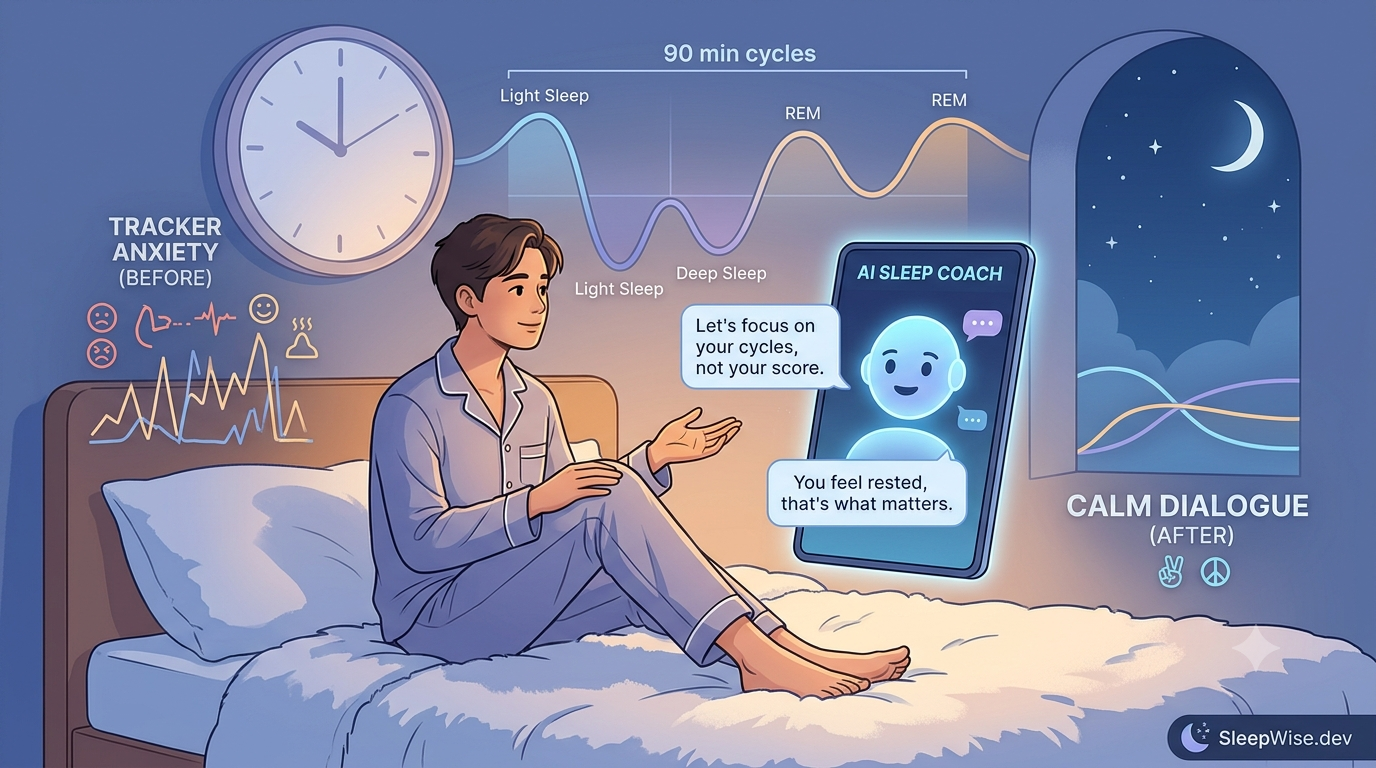
Sleep happens in roughly 90-minute blocks. You move through light sleep, deep sleep, and REM, then cycle back around. Wake up mid-cycle, during deep sleep, and you'll feel like garbage even if the clock says you got "enough" sleep.
The timing of your alarm relative to where you are in a cycle can be the difference between springing out of bed and lying there unable to form a coherent thought. Rather than lying awake calculating whether you'll "get enough," you can focus on completing the cycles you have time for.
A good conversational AI sleep coach should be reinforcing this logic, not fighting it. If a tool is still telling you "you need exactly 8 hours" without any mention of cycle timing, it's behind the curve.
Sleepmaxxing, TikTok, and Why Conversational Wellness Had to Happen
If you've spent any time on sleep TikTok, you've seen sleepmaxxing: mouth tape, weighted blankets, magnesium stacks, blue-light glasses worn at 4 PM, all stacked on top of each other in pursuit of the "perfect" night.
Maybe you've even cut caffeine (painful) or started meditating (does anyone actually stick with this?). Sleepmaxxing isn't inherently bad. Some of the underlying advice is solid. But the trend has quietly pushed a lot of younger adults straight into orthosomnia territory, treating sleep like a competitive sport instead of a biological process.
This is exactly where conversational AI sleep coaches can do something a TikTok trend can't: push back. A good AI coach, asked "should I be doing all of this," can actually say "probably not all at once" instead of just nodding along.
Sleep Anxiety at 3 AM: How a Conversational AI Sleep Coach Reframes It
Waking up at 3 AM gripped by anxiety is not a character flaw or a sign that something is permanently broken. Sleep anxiety is not simply feeling nervous about bedtime. It's a full physiological stress response triggered by worried thoughts about sleep itself.
The cycle feels endless: bad sleep → tired days → stress → worse sleep. A conversational AI sleep coach can interrupt that loop in the moment, the same way a calm friend would, by walking you through what's actually happening instead of letting your brain catastrophize alone in the dark.
The good news is that learned responses can be unlearned. Understanding this pattern gives you a practical lever you can pull tonight, no supplements, no gadgets required.
Pairing AI Coaching With Low-Tech Tools (Yes, Still Worth It)
Here's the thing nobody selling a $300 ring wants to say out loud: some of the best tools for sleep anxiety cost nothing.
Thought-dumping means writing down whatever's looping in your head before bed, getting it out of your skull and onto paper. Body scans mean slowly noticing tension from your toes to your scalp until your nervous system gets the memo that it's safe to power down.
4-7-8 breathing (inhale 4, hold 7, exhale 8) is another one worth trying, mostly because it forces your exhale to be longer than your inhale, which nudges your nervous system toward "rest" mode.
A conversational AI sleep coach doesn't replace these. It just reminds you to actually do them, which, let's be honest, most of us need.
Is Your Data Safe With a Conversational AI Sleep Coach?
Privacy is the quiet dealbreaker in all of this. Survey data shows that data privacy and security concerns are cited by 38.7% of people as a primary barrier to adopting sleep technology at all, AI-powered or not.
Did You Know?
Even trained human technicians scoring the exact same lab sleep data only agree with each other about 80% of the time.
Source: Sahha
That 80% stat is worth sitting with. If trained professionals disagree on the same dataset one out of every five times, an AI model is working with messy material too. None of this is reason to panic. It's reason to pick tools that are upfront about what they collect.
Before you hand any app months of sleep history, it's worth reading exactly how that data gets stored and used, the same way you'd check our own privacy policy before using a calculator that needs zero sign-up to begin with.
Conversational AI coaches are stepping in to cure data-obsessed sleepers.
Are Conversational AI Sleep Coaches Actually Worth Using?
Used right, yes. Conversational AI sleep coaches are genuinely useful when they push you toward better behavior instead of better scores. Used wrong, they're just orthosomnia with a chat interface.
The test is simple: does the tool make you feel calmer about your sleep, or more anxious about hitting a number? If it's the second one, close the app and go look at a cycle-based calculator instead. Sometimes the lowest-tech option, no account, no data collection, no score to obsess over, is the one that actually ends the cycle.
Conclusion
Conversational AI sleep coaches mark a real shift away from the score-chasing that defined the last decade of wearable tech. Orthosomnia happened because we handed people numbers without context, and conversational AI sleep coaches are, at their best, the correction to that mistake.
Whether you reach for Oura Advisor, Sleep Cycle's Luma, or just a straightforward cycle calculator, the goal is the same: less obsessing over a daily grade, more actually sleeping. Join the club of people who've decided the score doesn't get to run their morning anymore.
Frequently Asked Questions
What is orthosomnia and how do conversational AI sleep coaches help?
Orthosomnia is an anxious obsession with achieving a "perfect" sleep tracker score, affecting an estimated 3% to 14% of adults. Conversational AI sleep coaches help by giving context and reassurance through dialogue instead of a flat number, which lowers the anxiety that obsessive score-checking creates.
Is an AI sleep coach worth it in 2026?
For most people, a conversational AI sleep coach is worth trying if you already use a wearable and want help interpreting the data without spiraling. If you don't own a wearable, a free cycle-based calculator gets you most of the same practical benefit with none of the data privacy tradeoffs.
What's the difference between Oura Advisor and a regular sleep tracker?
A regular sleep tracker gives you a score. Oura Advisor and similar conversational AI sleep coaches let you ask follow-up questions in plain language, turning a static number into an actual conversation about what might be affecting your recovery.
Can AI sleep coaches actually cause orthosomnia instead of curing it?
Yes, if the tool is just a scorecard wearing a friendlier interface. A conversational AI sleep coach should reduce fixation on perfect numbers, not reinforce it, so the test is whether using it makes you feel calmer or more anxious about your sleep.
How accurate is sleep tracking data from wearables like Apple Watch?
Not as accurate as people assume. Studies have found devices overestimating light sleep by up to 45 minutes and underestimating deep sleep by 43 minutes in the same night, which is part of why conversational AI sleep coaches now emphasize patterns over single-night grades.
Do I need a wearable to use a conversational AI sleep coach or sleep calculator?
No. Cycle-based tools like our free Sleep Cycle Calculator work from bedtime and wake-time math alone, no wearable or account required, making them a low-anxiety starting point before adding any AI layer on top.
What is "sleepmaxxing" and is it related to orthosomnia?
Sleepmaxxing is the TikTok-driven trend of stacking sleep hacks (mouth tape, magnesium, weighted blankets) in pursuit of a flawless night. It overlaps heavily with orthosomnia because both treat sleep as a score to optimize rather than a biological process to support, which is exactly the mindset conversational AI sleep coaches are designed to soften.