 Sleep Tech & Wellness
Closed-Loop Neurofeedback for Deep Sleep Induction: Train Your Brain Into Deep Sleep in 2026
By Morgan Reed · Health and sleep science writer · Published July 1, 2026 · Updated July 1, 2026 · 8 min read
Can sleep tech do more than just track your rest? Learn how closed-loop neurofeedback uses real-time EEG, AI, and timed stimulation to help train your brain toward deeper, more restorative sleep in 2026.
Closed-Loop Neurofeedback for Deep Sleep Induction: The Best Tech-Backed Way to Train Your Brain Into Deep Sleep in 2026
Let's be honest. Falling asleep is easy. Staying in deep, restorative sleep without your brain glitching itself awake at 3 AM? That's the hard part, and it's exactly the problem closed-loop neurofeedback for deep sleep induction is built to solve. Roughly 70 million adults in the United States are dealing with some kind of sleep disorder, which is part of why this tech has gone from niche research labs to something you can strap to your head before bed.
Key Takeaways
- What it is: Closed-loop neurofeedback for deep sleep induction reads your brainwaves in real time and adjusts stimulation (sound, light, or electrical signals) to push you deeper into slow-wave sleep.
- How well it works: AI-powered neurofeedback simulations have shown a 23% average decrease in Wake After Sleep Onset (WASO), meaning fewer middle-of-the-night wake-ups.
- Sleep efficiency gains: Targeted EEG interventions have produced a measurable 13% improvement in overall sleep efficiency in controlled simulations.
- It's not a gimmick: This is grounded in real EEG sleep tech, not wellness marketing fluff.
- Pairs well with cycle math: Neurofeedback works best alongside an understanding of your own 90-minute sleep cycles, not against them.
- Who benefits most: People with fragmented sleep, light sleepers, and anyone whose sleep anxiety keeps them stuck in light-sleep stages.
- Free tool: You can map your ideal bedtime around full cycles with our free sleep cycle calculator, no account needed.
What Is Closed-Loop Neurofeedback for Deep Sleep Induction?
Here's the thing: most sleep tech just watches you. It records movement, heart rate, maybe some EEG, then hands you a report in the morning telling you how badly you slept. Cool. Too late to do anything about it.
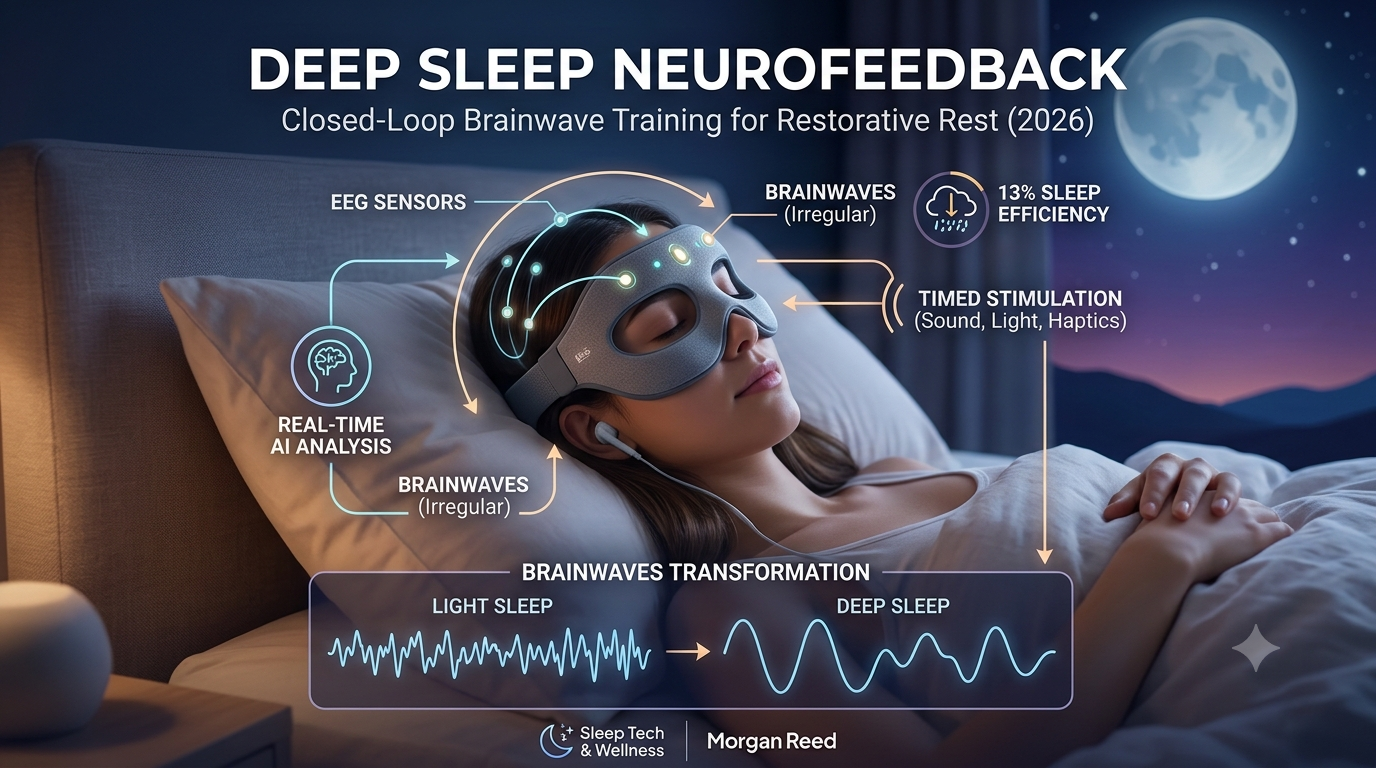
Closed-loop neurofeedback flips that. It watches your brain activity in real time and reacts to it while you're still asleep. Light beta waves creeping in, signaling you're drifting toward wakefulness? The system delivers a gentle audio tone, pulse, or light cue timed to nudge you back toward delta wave activity (the brainwave pattern associated with deep, slow-wave sleep).
That feedback loop, brain signal in → stimulation out → brain signal adjusts, is the whole point. It's not passive tracking. It's an active conversation between your brainwaves and the device.
How Closed-Loop Sleep Systems Read and Respond to Your Brainwaves
The mechanics behind closed-loop sleep systems sound complicated, but the logic is pretty simple once you break it down.
- EEG sensors detect brainwave patterns → the device identifies whether you're in light sleep, deep sleep, or REM.
- An algorithm classifies the sleep stage → modern systems use AI models (some Transformer-based) trained on huge EEG datasets to do this almost instantly.
- The system triggers targeted stimulation → this could be beta wave suppression, delta wave enhancement, or a precisely timed audio cue.
- Your brain responds → and the loop starts over, adjusting in real time rather than waiting for a morning report.
This is where the science gets genuinely interesting, not "biohacking influencer" interesting, but actual published-research interesting.
Did You Know?
AI-powered neurofeedback simulations using beta suppression and delta enhancement achieved a 23% average decrease in Wake After Sleep Onset (WASO).
Source: Journal of Computer Science
A 23% drop in middle-of-the-night wakeups isn't a rounding error. That's the difference between waking up groggy and disoriented versus actually feeling like a person in the morning.
Neurofeedback Masks: The Wearable EEG Sleep Tech of 2026
If you've scrolled past a sleek headband or eye mask covered in tiny electrode dots in your feed lately, that's the neurofeedback mask category, and it's having a real moment in 2026.
These masks combine soft EEG sensors with built-in speakers or haptic feedback, all packed into something thin enough to actually sleep in. No wires running to a bedside console. No lab-style cap full of gel electrodes.
What makes them part of the closed-loop sleep conversation (rather than just another tracker) is the in-ear or in-mask response system. The mask isn't just logging your brainwaves for later. It's reacting to them mid-cycle, which is the entire mechanism behind closed-loop neurofeedback for deep sleep induction.
- Comfort matters more than specs. A mask with perfect EEG accuracy that you rip off at 2 AM because it's uncomfortable does nothing for you.
- Battery life should cover a full night. Look for at least 8-10 hours so it doesn't die mid-cycle.
- Companion apps should show stage-by-stage data, not just a vague "sleep score."
Neural Music and Closed-Loop Audio: Does Sound Stimulation Actually Deepen Sleep?
Neural music is one of the more fascinating sub-categories here. It's not your standard white noise app playing the same eight-hour rain loop on repeat.
Closed-loop neural music systems generate (or select) audio in real time based on what your brain is currently doing. Drifting into light sleep when you should be deepening? The track shifts, tempo slows, frequencies adjust, all without waking you up to notice the change.
The theory here ties back to something called auditory closed-loop stimulation. Pink noise or tones delivered precisely during the "up-states" of slow-wave activity can reinforce and extend deep sleep. It's not magic. It's timing, and timing is exactly what closed-loop systems are designed to nail.
The good news is that learned responses can be unlearned, and your brain's sleep patterns are no exception. Closed-loop neurofeedback for deep sleep induction works because it meets your brain exactly where it is, cycle by cycle, instead of fighting against it.
EEG Sleep Tech in 2026: How Accurate Is It Really?
A fair question, and one worth asking before you spend money on anything. The accuracy of these systems hinges entirely on how well the underlying model classifies your sleep stages.
This is where AI has actually moved the needle. A Transformer-based AI model can now classify dysregulated EEG sleep epochs with up to 92% accuracy, which is a massive leap from earlier generation algorithms that relied on simpler rule-based scoring.
Did You Know?
A Transformer-based AI model can classify dysregulated EEG sleep epochs with 92% accuracy, a key reason closed-loop neurofeedback can react in real time without constant errors.
Source: Journal of Computer Science
That accuracy matters because a closed-loop system is only as good as its classification step. Misread a sleep stage → deliver the wrong stimulation → potentially wake someone up instead of deepening their sleep. Better models mean fewer mistimed nudges and more nights where the loop actually does its job.
If you want a deeper dive into how AI is reshaping sleep monitoring overall, our breakdown of AI-powered sleep monitoring covers the broader landscape beyond just neurofeedback.
Closed-Loop Neurofeedback vs Traditional Sleep Trackers: What's the Difference?
It's easy to lump all sleep tech together, but closed-loop neurofeedback and a standard wearable tracker are solving different problems.
Feature
Traditional Sleep Tracker
Closed-Loop Neurofeedback System
Data collection
Passive, logs movement/heart rate
Active, reads real-time EEG brainwaves
When you get feedback
Morning report, after the fact
During sleep, in real time
Can it intervene mid-sleep?
No
Yes, via audio/light/haptic stimulation
Primary goal
Awareness of past sleep
Active deep sleep induction
Best for
Tracking trends over time
People needing more deep sleep right now
Neither is "wrong." A tracker is great for spotting patterns over weeks. A closed-loop system is doing real work the night you're actually wearing it.
Who Should Try Closed-Loop Neurofeedback for Deep Sleep Induction?
This isn't a tool everyone needs. If you sleep fine, congratulations, genuinely, you don't need to overthink this.
But if any of this sounds familiar, closed-loop neurofeedback is worth a serious look:
- You fall asleep fine but wake up multiple times overnight.
- Waking up at 3 AM gripped by anxiety has become a recurring pattern, not a one-off.
- You've tried 4-7-8 breathing, cut caffeine, started meditating (does anyone actually stick with this?), and you're still not hitting deep sleep.
- You're chasing "sleepmaxxing" trends from TikTok but want something with actual research behind it instead of a routine that's mostly aesthetic.
Understanding this pattern gives you a practical lever you can pull tonight, no supplements, no guesswork, just a system reacting to your actual brain activity instead of a generic schedule.
Pairing Neurofeedback With Cycle-Based Sleep Planning
Here's something a lot of neurofeedback marketing skips entirely: timing your sleep around full 90-minute cycles still matters, even with the fanciest closed-loop mask on your head.
If a neurofeedback system successfully deepens your sleep but your alarm yanks you out mid-cycle, you're still going to feel like garbage. The science of sleep cycles and the science of neurofeedback aren't competing, they're complementary.
That's exactly why we built our sleep cycle calculator. Plug in either your wake time or your bedtime, and it works backward (or forward) through full 90-minute blocks so you're not springing out of bed groggy and disoriented, neurofeedback device or not.
What to Look for Before Buying a Closed-Loop Neurofeedback Device in 2026
The market for brain health devices, including sleep monitoring and neurostimulation systems, is projected to reach USD 13,996.76 million globally by 2033, so expect a flood of new products this year and next. Not all of them are created equal.
- Look for actual EEG sensors, not just heart rate or motion proxies pretending to be brainwave data.
- Check if it's truly closed-loop. Some "neurofeedback" products only log data and send a morning summary, which isn't closed-loop at all.
- Read how the company talks about accuracy. Vague marketing language is a red flag; specific classification accuracy numbers are a good sign.
- Comfort for full-night wear. A device you can't sleep in isn't a sleep device.
- Data privacy. You're sharing brainwave data overnight, every night, so it's worth knowing how that data is stored and used.
Closed-loop neurofeedback is driving massive valuations in the sleep health sector.
Conclusion: Is Closed-Loop Neurofeedback Worth It for Deep Sleep in 2026?
The cycle feels endless for a lot of people: bad sleep → tired days → stress → worse sleep. Closed-loop neurofeedback for deep sleep induction won't fix every cause of bad sleep, and we're not going to pretend it's a miracle cure.
But for people stuck in fragmented, restless nights, the research backing it (23% less time awake overnight, 13% better sleep efficiency, 92% accurate EEG classification) is genuinely promising, not hype. Pair it with an understanding of your own sleep cycles, give your brain consistent, well-timed feedback, and deep sleep stops feeling like something that just happens to other people.
Frequently Asked Questions
What does closed-loop neurofeedback for deep sleep induction actually mean?
It means a device reads your brainwaves in real time and adjusts stimulation, like sound or light, based on what your brain is doing right now. The "closed-loop" part refers to that continuous feedback cycle happening while you're actually asleep, not after.
Is closed-loop neurofeedback better than a regular sleep tracker?
They do different jobs. A tracker logs data for you to review in the morning, while closed-loop neurofeedback intervenes during the night itself to actively push you toward deeper sleep stages.
Do neurofeedback masks really work for deep sleep?
Research on EEG-based stimulation shows real improvements, including a 23% decrease in nighttime wake-ups and a 13% boost in sleep efficiency in controlled studies. Results vary by person and by device quality, so accuracy and comfort both matter a lot.
Is neural music part of closed-loop neurofeedback?
Yes, neural music systems that adjust audio in real time based on your brainwave activity are a form of closed-loop stimulation, specifically auditory closed-loop stimulation. It's the same underlying logic as a neurofeedback mask, just delivered through sound instead of light or haptics.
Is closed-loop neurofeedback for deep sleep induction worth it in 2026?
For people dealing with fragmented sleep or frequent overnight wake-ups, the data suggests yes, it's worth trying. With over 70 million American adults affected by sleep disorders, the demand (and the research) behind this tech keeps growing fast.
Can EEG sleep tech replace good sleep habits?
No, and it shouldn't try to. Closed-loop neurofeedback works best alongside basics like consistent sleep cycle timing, which is exactly why pairing it with a 90-minute cycle approach tends to produce better results than relying on the device alone.
How accurate is EEG sleep tech in 2026?
Modern AI models used in closed-loop systems can classify EEG sleep stages with up to 92% accuracy, a significant jump from earlier rule-based scoring methods. Higher accuracy means the system delivers stimulation at the right moment instead of mistiming the feedback loop.